
 SINCE 1993 MADE IN USA | ISO 9001:2015 | 303.684.0931 | CONTACT US SINCE 1993 MADE IN USA | ISO 9001:2015 | 303.684.0931 | CONTACT US
Plastics have become integral to the industrial market. Plastics offer a versatile, durable, and cost-effective alternative to traditional materials like metals and glass. Their unique properties such as lightweight construction, chemical resistance, flexibility, and ability to be molded into complex shapes make plastics essential across a wide range of industries. The adaptability of plastics, combined with advancements in polymer technology, has made them invaluable for improving efficiency, reducing costs, and meeting specific performance requirements in industrial applications.
AIM Processing has the flexibility to quickly apply a team to your project and has the capacity to meet your high-volume requirements. Our experienced engineering team helps with material selection, tooling design, and manufacturing processes to provide you with the most cost-effective components for your product.
High-capacity production
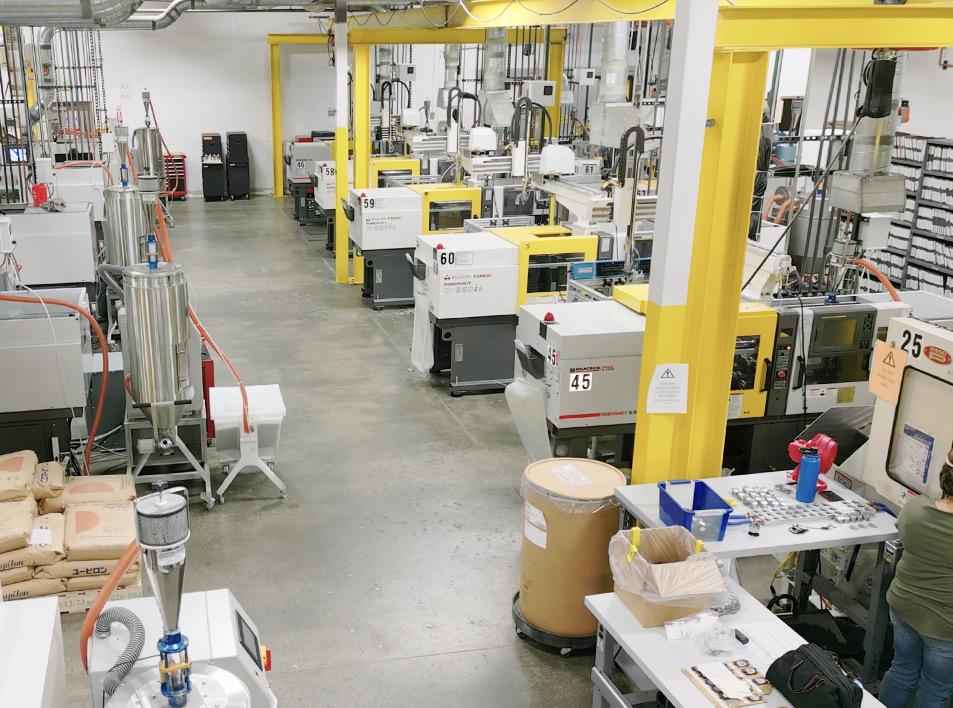
With 37 presses that run 24 hours a day and 7 days a week, AIM Processing can handle any size injection molding project. We have a combination of automated, lights-out production and press-side attended operations. We can manufacture large batch and small batch injection molded small parts with maximum efficiency and low cost.
High production efficiency
Supply chain efficiency and sophisticated forecasting models enable us to ship over 85% of custom parts from stock. That allows us to provide on-time delivery. In addition, we will stock your parts for same day order fulfillment and just-in-time delivery.
Maximizing tool performance
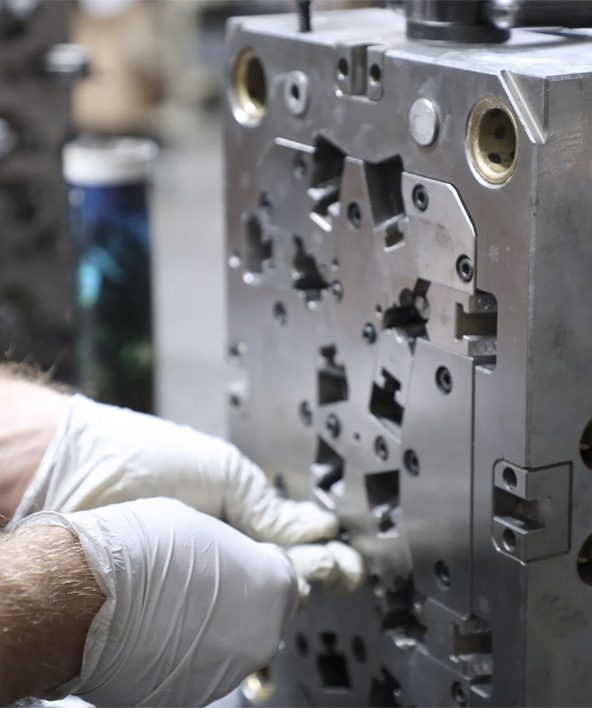
Our in-house tooling team works with the most skilled and experienced toolmakers to provide the highest quality tooling for your part. The result is a forward-thinking design that allows for simplified adjustments. The designs will be steel-safe which also permits cost-effective adjustment when necessary.
Our in-house tooling team maintains and keeps your tooling clean. We ensure that the tool continues to supply quality parts that meet all required specifications during every production run. Our care for your tooling optimizes the life of the tool to maximize your return-on-investment.
Specialized skills
Our advanced plastic injection molding technology can create durable, lightweight plastic alternatives to metal components. This expertise improves product performance and reduces part weight and cost. We also have expertise in molding and overmolding to add a gripping or a sealing surface to a metal part. Examples of overmolding include the manufacture of filters, threaded inserts, electronic circuits, and electronic connectors.
Precision manufactured parts
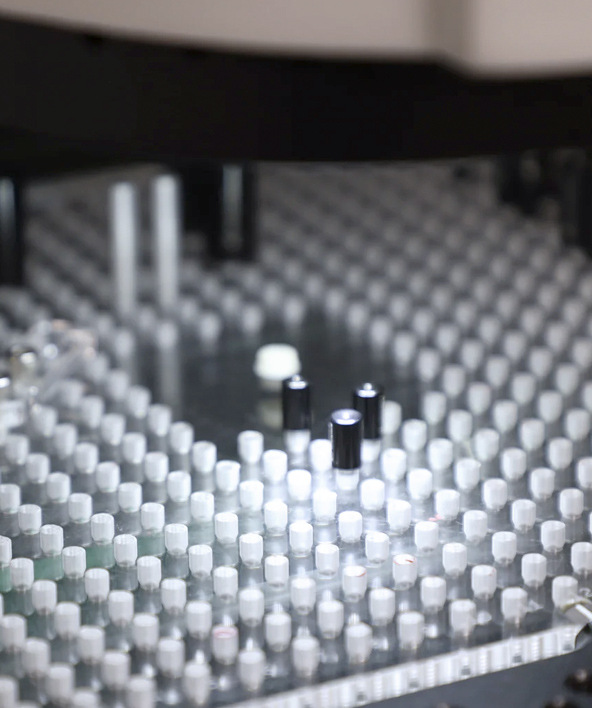
If you have a part that must fit tightly into a precision assembly, we can produce small parts with tolerances of ±0.001 inch. For example, we can reliably make parts with clearance holes having diameters of 0.01 inch. That capability allows us to manufacture 100% yield components in high volume runs without the need for detailed part inspection.
Additional manufacturing services
To help you reduce your manufacturing costs and manufacturing steps, we can perform sub-assembly work. If needed, we also can conduct ultrasonic welding and heat staking. Furthermore, we can laser etch and mark parts for identification and traceability. We offer these services to allow you to have a more cost-efficient manufacturing process.
Quality-focused for consistent production
You can have confidence in the parts we manufacture for you. We are committed to the highest quality standards as evidenced by our ISO 9001:2015 registration. We execute a documented set of procedures to provide you with consistent parts that meet and exceed your requirements.
We can solve your challenges with our innovative and cost-effective solutions for injection molded components.
Contact us today to discuss your requirements.
Industrial injection molding is a manufacturing process used to produce high-volume, precision plastic components for various industries, including automotive, medical, electronics and consumer goods. It involves injecting molten plastic into a mold to create complex and durable parts with consistent quality. This process allows for cost-effective mass production, design flexibility and the use of a wide range of materials suited for specific industrial applications. Industrial injection molding is essential for manufacturing strong, lightweight and reliable components used in everyday products and advanced machinery.
Injection molding in manufacturing works by injecting molten plastic into a precisely designed mold under high pressure. The material is heated until it becomes liquid and then injected into the mold cavity, where it cools and solidifies into the desired shape. Once hardened, the finished part is ejected from the mold and undergoes any necessary finishing processes. This method is widely used for producing high-volume, consistent and complex plastic components with minimal waste, making it essential in industries such as automotive, medical and consumer goods manufacturing.
Injection molding offers several advantages in industrial production, including high efficiency, cost-effective mass manufacturing and precise repeatability. It allows for the creation of complex and detailed parts with minimal material waste. The process supports a wide range of durable and high-performance plastics, ensuring strength, flexibility and resistance to heat or chemicals. Additionally, injection molding reduces labor costs, shortens production cycles and enables the integration of multiple features into a single part, making it ideal for industries such as automotive, medical, and consumer goods manufacturing.
Common materials used in industrial injection molding include thermoplastics such as polypropylene (PP), polyethylene (PE), polycarbonate (PC) and acrylonitrile butadiene styrene (ABS). These materials are chosen for their durability, flexibility and resistance to heat, chemicals and impact. Other commonly used plastics include nylon (PA) for high-strength applications, polyether ether ketone (PEEK) for extreme performance needs and liquid silicone rubber (LSR) for flexible, heat-resistant components. The choice of material depends on the specific requirements of the industry, such as strength, weight and environmental resistance.
Injection molding is used in manufacturing parts by injecting molten plastic into a custom-designed mold under high pressure. Once the material cools and solidifies, the mold opens to release the finished part. This process allows for the efficient production of high-precision, complex components with consistent quality. It is widely used across industries such as automotive, medical, electronics, and consumer goods to manufacture durable and lightweight parts, including housings, gears, enclosures and structural components. Injection molding is preferred for its cost-effectiveness, scalability and ability to produce intricate designs with minimal waste.
“We received the charger base and I want you all to know it looks FANTASTIC! Thank you for getting us this one for the BOD meeting.”
Joe P., President,
medical device company
“…thanks for all of your hard work as well as others at your facility in making this happen.”
Ron H., Quality Control Manager,
industrial product company