 SINCE 1993 MADE IN USA | ISO 9001:2015 | 303.684.0931 | CONTACT US SINCE 1993 MADE IN USA | ISO 9001:2015 | 303.684.0931 | CONTACT US
Explore AIM Processing’s insert molding and overmolding services, offering innovative solutions to enhance product functionality by combining different materials or integrating components directly into plastic parts.
Expertise for optimum material selection
Our mechanical engineers have expertise and experience with a broad range of engineering plastics. For parts used in medical devices, our engineers can provide guidance on the optimum medical grade plastic that will meet part requirements and regulatory requirements.
Disciplined process development
Our engineering team of materials engineers, process engineers, and quality engineers will work with your engineers to ensure a cost-effective manufacturing process. If needed, we can make recommendations for tooling to meet critical dimensional requirements. The team will define process steps, tool maintenance procedures, and quality control measures to maintain a dimensionally stable part.
Additional manufacturing services
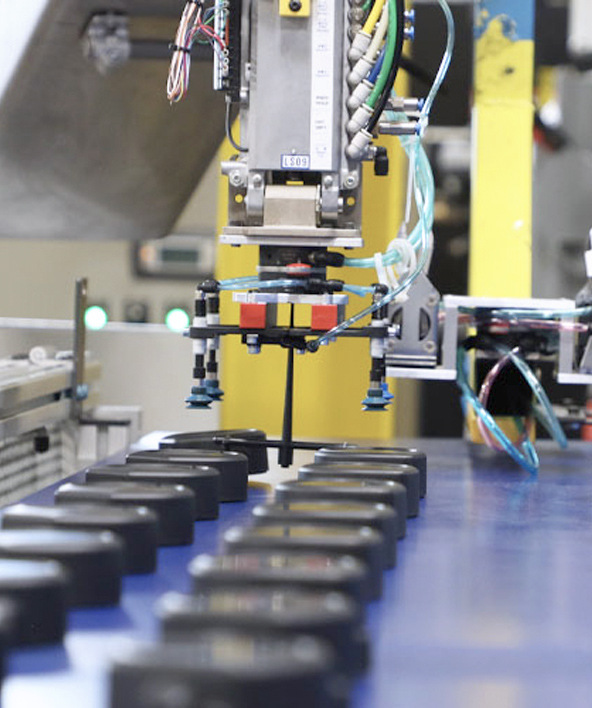
To help you reduce your manufacturing costs and manufacturing steps, we can perform sub-assembly work. If needed, we also can conduct ultrasonic welding and heat staking. Furthermore, we can laser etch and mark parts for identification and traceability.
Tight tolerances for precision assemblies
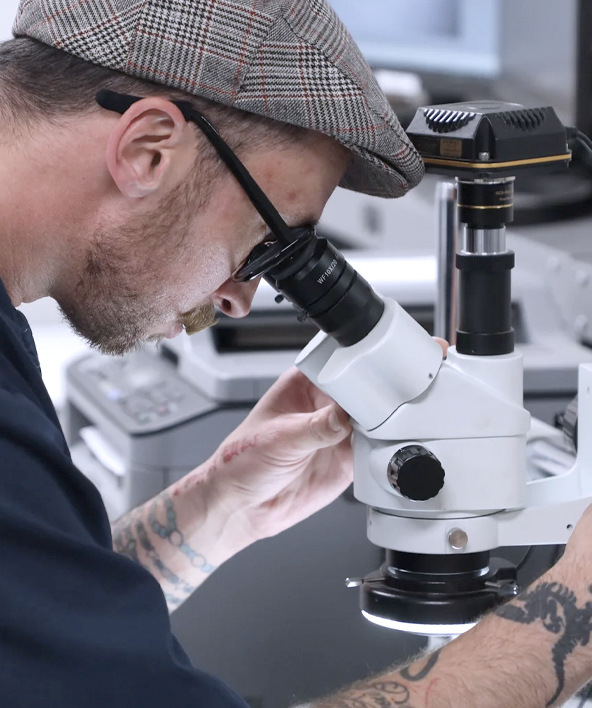
If you have a part that must fit tightly into a precision assembly, we can produce small parts with tolerances of ±0.001 inch. That capability allows us to manufacture 100% yield components in high volume runs without the need for detailed part inspection.
For example, we make a multi-cavity part for a medical device manufacturer that has 14 holes with the diameter of a human hair. With the tolerance we can achieve, we produce a million of these parts each year with 0 defects.
Maximizing tool performance
Our in-house tooling team maintains and keeps your tooling clean and running at optimum performance. We ensure that the tool continues to supply quality parts that meet all required specifications during every production run. Our care for your tooling optimizes the life of the tool to maximize your return-on-investment.
Quality-focused for consistent production
You can have confidence in the parts we manufacture for you. We are committed to the highest quality standards as evidenced by our ISO 9001:2015 registration. We execute a documented set of procedures to provide you with consistent parts that meet and exceed your requirements.
High-capacity manufacturing
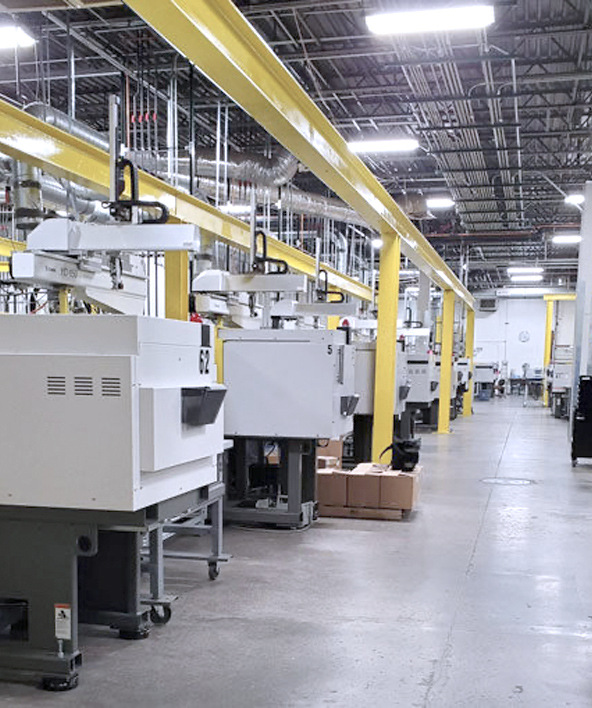
We operate 37 state-of-the-art presses and operate on a 24 hour/7 day a week schedule. With a mixture of automated, lights-out production and press-side attended operations, we achieve high quality and low costs. This arrangement allows us to meet both high volume and low volume requirements.
Long-term partnerships
We pride ourselves in fostering long-term partnerships with our clients. Our engineering team is always available to consult on design improvements, material selection, and cost optimization.
Together, we can solve your challenges with our innovative and cost-effective solutions for injection molded medical components.
Contact us today to discuss your requirements.
Medical injection molding is a manufacturing process used to produce precise, high-quality plastic components for medical devices and equipment. It involves injecting molten plastic into a mold under high pressure, allowing for the mass production of parts with tight tolerances and consistent quality. This process is commonly used to create syringes, IV components, surgical instruments and implantable devices, ensuring they meet strict regulatory and sterilization requirements.
Injection molding is widely used in medical device manufacturing to produce high-precision, sterile and durable plastic components at scale. It allows for the creation of complex shapes with tight tolerances, essential for medical devices such as syringes, catheters, surgical instruments and implantable components. The process supports biocompatible and medical-grade plastics, ensuring safety and compliance with industry regulations. Additionally, injection molding enables cost-effective mass production while maintaining consistency and quality in each part.
Injection molding offers several benefits in the medical industry, including high precision, consistency and cost-effective mass production. It allows for the use of medical-grade, biocompatible plastics that meet strict regulatory standards. The process supports complex designs with tight tolerances, making it ideal for producing components like syringes, catheters and surgical instruments. Additionally, injection molding ensures a high level of sterilization compatibility and minimizes material waste, making it an efficient and reliable manufacturing method for medical devices.
Injection molding is used to make many medical devices including syringes, catheters, IV components, surgical instruments and implantable devices. This process is also used to manufacture diagnostic test kits, drug delivery systems and housings for medical equipment. Injection molding enables the production of complex, high-precision parts using biocompatible materials that meet strict medical industry standards for safety and sterilization.
Medical injection molding uses a variety of biocompatible and medical-grade materials, including thermoplastics such as polycarbonate, polypropylene, polyethylene and polyether ether ketone (PEEK). These materials are chosen for their durability, chemical resistance and ability to withstand sterilization processes. Other commonly used materials include liquid silicone rubber (LSR) for flexible components and resins with antimicrobial properties to enhance patient safety. Each material is carefully selected to meet strict regulatory and performance requirements in medical applications.
“We received the charger base and I want you all to know it looks FANTASTIC! Thank you for getting us this one for the BOD meeting.”
Joe P., President,
medical device company
“…thanks for all of your hard work as well as others at your facility in making this happen.”
Ron H., Quality Control Manager,
industrial product company