SINCE 1993 MADE IN USA | ISO 9001:2015 | 303.684.0931 | CONTACT US
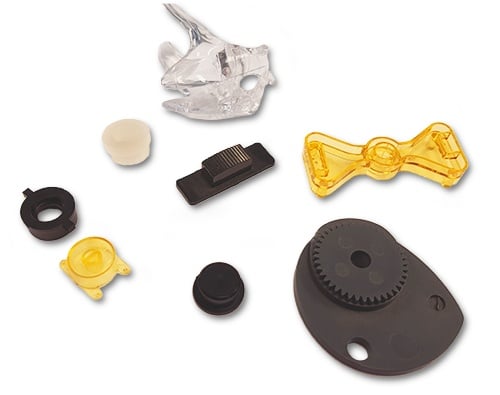
Discover AIM Processing's customer small part injection molding services, designed to deliver precise, high-quality components for industries requiring intricate and complex plastic parts.
AIM Processing specializes in small part plastic injection molding. We define "small plastic parts" as roughly the size of your fingernail to the size of your hand. Injection molding is a process in which plastic resin, in pellet form, is heated and sheared until it reaches a viscous state.
It is then injected under enormous pressure into a steel or aluminum mold, cooled until it hardens, and ejected. With small part injection molding, we are able to manufacture complex, small shapes in a cost-effective, repeatable process.
As a leading small plastic parts manufacturer, we work with engineering grade plastics to create custom molded plastic parts that match the requirements for a part with properties like: chemical resistance, flexural strength, durometer, and yield strength to name a few. There are so many material options, and we can help you make the right choice for your program.
The design and manufacture of custom molded plastic parts can seem simple at first, but there are many details that must be taken into consideration depending on how the part will be used. For example, there are mechanical properties like:
Material properties, such as:
And, cosmetic aspects like:
Then there are factors like the manufacturability of gate locations, draft, and ejector pins. It's enough to make your head spin.
Let us help you define the requirements for your next project.
Outsourcing manufacturing overseas can deliver initial cost savings, but quality issues often erode those gains. Even with lower-cost hand assembly, ...
Read MoreGreat plastic parts don’t emerge from the press unless they first start at the design desk. The injection molding industry is entering a new era. ...
Read MoreAs a manufacturing manager, you know the frustration: Parts arriving with inconsistent quality. Missed delivery deadlines. Phone calls and emails ...
Read More

An injected molded part is a plastic part made by a multi-step manufacturing technique that melts granular or pellet thermoplastic polymers in a heated barrel. A press injects the molten material under pressure into a metal mold which has been machined to form the shape of the plastic part. The mold is cooled allowing the material to solidify into the shape of the mold. When the part has cooled to a solid form, the mold opens and the part is ejected. A final finishing step may involve trimming or surface treatments.
Injection molding produces plastic parts with complex shapes in high volumes. Plastic injection molded parts are used in a wide range of industries. For example, in the automotive industry, injection molded parts are used for components like air vents, clips and handles. In consumer goods, it is used to create items such as toys, kitchen utensils and appliances. The electronics industry, the aerospace industry, the construction materials industry and the sports and leisure industry are examples of the many other industries that use plastic injection molded parts.
A plastic injection molding machine consists of three major subsystems. The injection subsystem melts the plastic material and injects it into the mold. The clamping subsystem holds the mold in place and provides the force to keep the mold closed during injection and until the material solidifies. The mold in the clamping subsystem is the machined tool that creates the shape of the final part. An ejector in the clamping subsystem pushes the molded part out of the mold. The third subsystem is the control unit, which regulates the machine’s operation and manages parameters such as temperature, pressure and timing.
Designing a plastic injection molded part requires experience with and knowledge of the injection molding manufacturing process, material properties of various plastics and cost-effective design principles. Understanding the material involves factoring in shrinkage during cooling to comply with dimension specifications. It's important to maintain uniform wall thickness and use gradual transitions where thickness changes are necessary to avoid warping. Design draft angles, tapers on vertical surfaces to allow easier ejection of the part from the mold without damaging the part. Design ribs to increase strength and stiffness of the part. Other important design practices include avoiding sharp corners to reduce stress concentrations that can lead to failure, providing flat surfaces for ejector pin contact, ensuring sufficient flow paths for the molten plastic to fill the mold and adding vents to prevent air pockets.
Plastic injection molded parts can have complex shapes and be produced in high volume. Examples of complex shapes include threads, ultrasonic welding ribs and latching features. Plastic injection molding can produce parts with tight tolerances of ±0.005 inches or even more narrow tolerances. With proper design of the mold tool and the molding process, injection molding provides high repeatability and a very consistent dimensioned product. Additionally, injection molding generates less waste than machining and reduces costs through automation.
“We received the charger base and I want you all to know it looks FANTASTIC! Thank you for getting us this one for the BOD meeting.”
Joe P., President,
medical device company
“…thanks for all of your hard work as well as others at your facility in making this happen.”
Ron H., Quality Control Manager,
industrial product company