
 SINCE 1993 MADE IN USA
Outsourcing manufacturing overseas can deliver initial cost savings, but quality issues often erode those gains. Even with lower-cost hand assembly, products with delicate components or intricate designs frequently suffer from inconsistent quality. As manufacturers reconsider their production strategies and look to reshore production, many are discovering the advantages of overmolding to protect delicate connections and components. Overmolding is a precise injection molding technology that protects components with a consistency that decreases product defects and rejections, improving both brand reputation and the bottom line.
What is Overmolding?
Overmolding is an injection molding process where components—whether metal parts, filter media, or a first-shot plastic part—are loaded into a mold, and a second material (often a soft thermoplastic) is molded around or onto them to capture, seal, or enhance the assembly.
You encounter overmolded products daily: the soft grip on your toothbrush, comfortable handles on power tools, the rubberized coating on electronic device cases, and ergonomic grips on kitchen utensils. In these consumer applications, overmolding adds comfort, improved grip, and aesthetic appeal.
However, overmolding's most sophisticated applications go far beyond ergonomics. For manufacturers of medical devices, industrial electronics, and precision instrumentation, overmolding serves critical protective functions: sealing delicate components against water and contaminant ingress, capturing fragile filter media or thin materials that would be difficult to assemble manually, and creating tamper-proof enclosures for sensitive electronics. In these applications—where sealing integrity, component protection, and consistent quality are non-negotiable—overmolding provides solutions that manual assembly and traditional gasket-based sealing simply cannot match.
Overmolding vs. Insert Molding
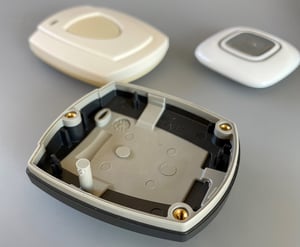 While both overmolding and insert molding involve combining multiple components or materials in the molding process, they serve different purposes. Insert molding typically refers to placing metal or other components (like threaded inserts or electrical contacts) into a mold cavity before injecting plastic around them to create embedded features in plastic housings.
Overmolding involves loading components or a first-shot plastic part into a mold and then molding a second material around or onto them to capture, seal, or enhance the assembly. The process can use specialized equipment like vertical presses that allow gravity-loading of delicate components that would be difficult to position in horizontal presses.
Solving Critical Sealing and Assembly Challenges
For medical devices, electronic enclosures, and industrial equipment, overmolding addresses recurring pain points that manual assembly and traditional methods struggle to solve consistently.
Superior Ingress Protection
Many electronic devices and medical instruments must meet stringent standards like IP66 or NEMA 4X for water and air infiltration. Manufacturers traditionally rely on gaskets and manual assembly to create seals, but this approach creates multiple problems. Gaskets require precise manual placement—if an O-ring isn't seated perfectly or protrudes from the edge, the product leaks and fails testing. The labor cost of gasket installation combines with high rejection rates to create ongoing expense.
Overmolding creates consistent, reliable seals by molding soft material directly onto hard plastic substrates, eliminating both labor costs and testing failures. For battery cases and electronic enclosures requiring IP66 or NEMA 4X certification, overmolding plastic-on-plastic around sealing regions delivers the consistency needed to pass standards testing reliably while reducing labor and scrap from failed tests.
Integrated Functionality and Protection
 Industrial applications demonstrate overmolding's ability to deliver multiple protective functions simultaneously. Chemical sensing devices worn in hazardous industrial environments where chemical interactions can create a toxic combination of gases if inhaled, require comprehensive protection that only overmolding can provide efficiently.
These handheld devices feature bright safety orange soft overmolds covering the electronic package completely—head to toe, front to back. The overmold seals case halves to prevent uncontrolled air infiltration that would contaminate gas samples, provides a secure grip for handheld use, offers drop protection for sensitive electronics, and ensures high visibility for safety compliance. The key is that overmolding integrates all of these protective features into a single manufacturing operation rather than requiring multiple assembly steps.

Material Selection and Process Precision
Overmolding typically employs one of three thermoplastic materials:
- TPEs (thermoplastic elastomers)
- TPUs (thermoplastic urethanes)
- TPVs (thermoplastic vulcanizates)
Each offers different chemical resistance, hardness, and tactile properties suited to specific applications. The adhesive bond between overmold and substrate provides long-term durability that manual assembly cannot replicate.
Success requires exceptional precision. Preventing plastic from flowing into unwanted areas demands meticulous mold design and experienced toolmakers who understand overmolding's unique requirements. The tooling must be designed so that the final product is both robust and aesthetically appealing—important for medical devices and professional instruments that must project quality and reliability.
The Business Case: ROI Beyond Initial Cost
The primary barrier to overmolding is tooling investment, with typical ROI around 18 months. However, this calculation changes dramatically when manufacturers account for the full cost of manual assembly: ongoing labor expenses, wet process management difficulties (gluing operations are notoriously inconsistent), rejection rates from failed testing, field failures, warranty claims, and potential contract losses.
Early Engagement: The Key to Success
Critical to overmolding success is early engagement in the design process. When product designs advance too far before evaluating overmolding, companies often face difficult choices. Finalizing case design, electronics layout, and circuit boards before considering manufacturing methods can require expensive redesigns affecting the entire product system.
What seems like a simple process change can cascade into modifications of disposable components, outer enclosures, electronics, and PCBs. Retrofitting overmolding into a finalized design is significantly more challenging and costly than designing it from the start. Manufacturers who engage molding partners early in the design phase—before locking in product architecture—can optimize designs to take full advantage of overmolding's capabilities while avoiding costly redesigns.
From Assembly Line to Integrated Manufacturing
Overmolding eliminates secondary operations that add cost and variability. Products arrive complete with all seals and touch buttons installed, removing the need for workers to manually add O-rings, snap components into place, or install buttons and seals from the back of cases. This streamlines production while dramatically improving consistency.
For manufacturers of medical devices, industrial electronics, and precision instrumentation—where sealing integrity, durability, and quality are non-negotiable—overmolding transforms manufacturing from variable assembly operations into reliable, integrated production. When quality problems threaten contracts, regulatory compliance, or brand reputation, overmolding delivers products engineered to perform consistently in the most demanding applications.
For manufacturers of industrial electronics, medical devices, and wearable technology—where precision sealing, durability, and quality are non-negotiable—overmolding transforms manufacturing from variable assembly operations into reliable, integrated production. When quality problems begin outweighing labor savings, overmolding delivers products ready to perform consistently in demanding applications.
To ask whether your project could benefit from overmolding or insert molding, contact the engineering staff at AIM Processing.